
By Dr Natalie Flatt, PhD – Connect Psych Services
The most significant workplace risk facing organisations today may not be uncertainty itself, but the cumulative psychological impact of living and working through it.
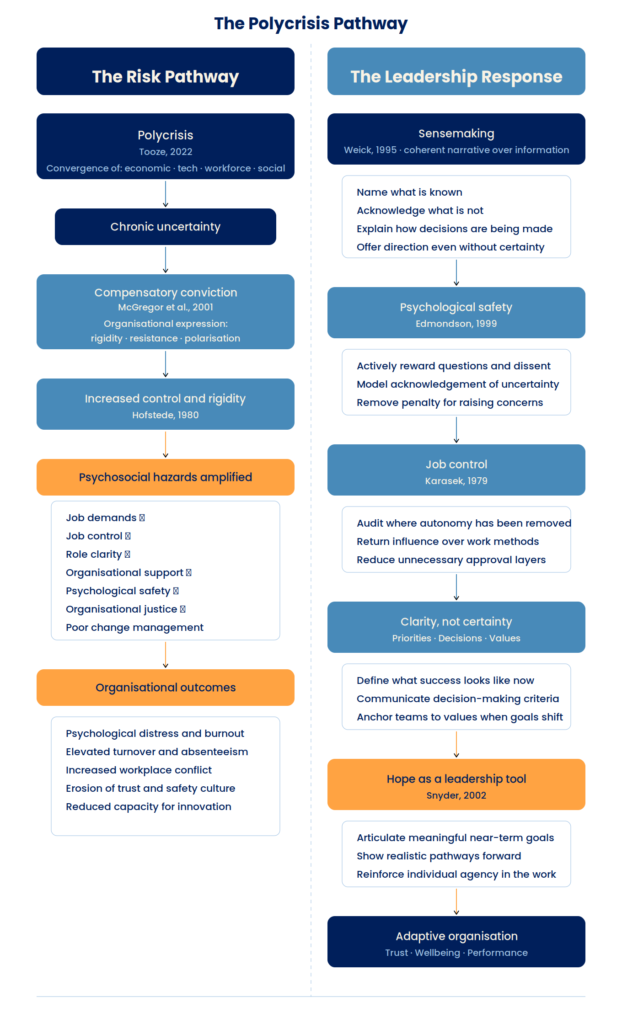
We are living through what social scientists increasingly describe as a polycrisis (Tooze, 2022): a period in which multiple crises unfold simultaneously and interact in ways that amplify their collective impact. Economic volatility, technological disruption, workforce shortages, geopolitical instability and social fragmentation are no longer isolated events to be managed independently. They are converging, creating an operating environment characterised by persistent uncertainty.
The consequences of this uncertainty extend well beyond organisational strategy. Increasingly, they are shaping how people think, behave and function at work.
Psychological research suggests that human beings rely heavily on their capacity to imagine and anticipate possible futures. This ability supports decision-making, goal setting, motivation and wellbeing. Yet emerging evidence indicates that uncertainty may impair this capacity. When individuals are confronted with an unpredictable future, they generate fewer possible pathways forward, report less confidence in their plans and find it more difficult to connect with their aspirations and goals.
This finding aligns with broader research on future self-continuity (Hershfield, 2011), possible selves (Markus & Nurius, 1986) and Hope Theory (Snyder, 2002), all of which suggest that the ability to imagine a meaningful future is central to adaptive functioning. The implications for organisations are significant. Employees who struggle to envision future possibilities may become less willing to invest effort in shaping them.
Perhaps the greatest cost of uncertainty is not the distress it creates, but the future it quietly erodes.
Why uncertainty does not produce the response we expect
A common assumption in leadership discourse is that uncertainty stimulates adaptability and innovation. However, psychological evidence suggests a more complex reality.
McGregor and colleagues (2001) found that threats to certainty, meaning and identity often trigger what they described as compensatory conviction. Rather than becoming more open to new ideas, individuals become more firmly attached to existing beliefs, established processes and familiar ways of working. Uncertainty does not necessarily increase flexibility. In many cases, it narrows it.
Within organisations this often appears as resistance to change. Teams become increasingly attached to legacy systems. Long-standing practices are defended more vigorously. Professional identities become more rigid. Silos strengthen. What leaders frequently interpret as resistance may instead represent an attempt to restore psychological stability in an environment that feels increasingly unpredictable.
Organisations themselves exhibit similar responses. Hofstede’s (1980) work on uncertainty avoidance demonstrated that cultures often manage ambiguity through rules, structures and formal processes. When organisations experience disruption, the instinctive response is frequently to tighten control. Additional approval layers are introduced. Governance expands. Reporting requirements increase. Decision-making becomes more centralised.
These interventions are usually implemented with good intentions. They are designed to create stability. Yet they can produce the opposite effect, reducing organisational agility while simultaneously removing the autonomy employees need to cope with elevated demands.
When a strategic challenge turns into a psychosocial risk
This is the point at which uncertainty transitions from a leadership challenge to a workplace health and safety concern.
Uncertainty is not currently recognised as a discrete psychosocial hazard within Australian WHS frameworks. However, it may function as a powerful psychosocial risk multiplier.
The Job Demands-Resources Model (Bakker & Demerouti, 2007) provides a useful lens through which to understand why. According to the model, psychological strain emerges when job demands exceed the resources available to manage them. Periods of uncertainty typically increase demands. Employees must adapt to changing priorities, evolving roles, new systems and ongoing ambiguity. Simultaneously, many of the resources that protect wellbeing begin to diminish. Role clarity declines. Predictability decreases. Confidence in decision-making weakens. Social support becomes strained.
The result is a dual pressure. Uncertainty increases demands while simultaneously eroding the resources required to manage them.
From a psychosocial risk perspective, this is particularly significant because it creates the conditions associated with recognised workplace hazards, including high job demands, low job control, poorly managed organisational change, inadequate support and poor organisational justice. Time and time again, I see organisations invest substantially in wellbeing initiatives while leaving the underlying drivers of strain untouched.
What this looks like in practice
Consider a professional services organisation employing approximately 120 people. Over three years, the organisation has experienced rapid growth. New clients are acquired. Technology platforms are introduced. Reporting structures evolve. Several senior leaders depart.
Individually, none of these events is problematic. Collectively, however, they generate a level of ambiguity that employees struggle to navigate.
Roles evolve faster than position descriptions can be updated. Managers receive inconsistent information regarding strategic priorities. Different teams begin operating from different assumptions about what success looks like. Informal communication fills the gaps left by uncertainty. Rumours emerge. Trust begins to erode.
When employee survey results eventually surface, the concerns raised relate to communication, workload, role clarity and support. The presenting issue appears to be engagement. The underlying mechanism is psychosocial risk amplified by unmanaged uncertainty.
This pattern is not unique to growth environments. Similar dynamics emerge during restructures, mergers, technological transformation and regulatory change.
What a reasonably practicable response looks like
Under Australia’s model WHS legislation and the 2022 psychosocial hazard amendments, the duty to eliminate or minimise psychosocial risks applies regardless of whether an organisation recognises uncertainty as the driver. The question is what a reasonably practicable response requires.
At minimum it means integrating uncertainty into psychosocial risk identification, rather than treating it as background noise outside the scope of assessment. During periods of significant change, the relevant questions extend beyond the specific change being managed to the cumulative ambiguity employees are carrying.
Have responsibilities changed without corresponding updates to role clarity?
Has workload increased without additional resources?
Do managers have sufficient information to provide clear direction?
Are governance processes supporting performance or unintentionally creating additional strain?
Weick’s (1995) research on sensemaking clarifies why communication volume alone is insufficient. People in conditions of genuine ambiguity need more than information. They need interpretation: help understanding what events mean and what they should do differently. When leaders fail to provide this, employees construct their own explanations, typically shaped by anxiety rather than evidence. The cumulative effect on trust is significant and far harder to reverse than to prevent. Leaders must distinguish between communicating and making sense, and between certainty, which is often unavailable, and clarity, which is always achievable. Clarity about priorities, decision-making criteria and organisational values gives people something to orient toward even when the destination is not yet fixed.
And the human response falls back to ‘perception is reality’. When leaders fail to provide coherent narratives, employees construct their own. These narratives are often shaped more by anxiety than evidence, contributing to cynicism, speculation and declining trust.
Building conditions that protect
Research consistently identifies several protective factors that help organisations navigate uncertainty more effectively.
Psychological safety (Edmondson, 1999) remains one of the most important. Employees need environments in which they can raise concerns, ask questions and acknowledge uncertainty without fear of negative consequences.
Job control is equally critical. Karasek’s (1979) Demand-Control Model demonstrated that high demands become substantially more harmful when individuals have limited influence over how work is performed. During periods of disruption, leaders should carefully examine whether governance changes have inadvertently removed autonomy from the very people who need it most.
Finally, hope deserves greater attention within workplace health and safety discussions.
According to Snyder’s Hope Theory (2002), hope is not simply optimism. It is a cognitive process involving meaningful goals, realistic pathways and a belief in one’s capacity to influence outcomes. Importantly, hope does not require certainty. It requires direction.
Leaders who can articulate credible goals, identify realistic pathways forward and reinforce employee agency are doing more than supporting engagement. They are helping to protect one of the most important psychological resources available to individuals and organisations alike.
The operating environment has changed
For many organisations, uncertainty is no longer an episodic disruption. It is the operating environment. That requires a shift in how safety practitioners and leaders think about psychosocial risk, away from point-in-time assessment toward ongoing attention to the conditions that uncertainty reliably creates and worsens. The organisations that navigate the polycrisis most effectively will not be those experiencing the least disruption. They will be those who recognise its psychological cost, understand its relationship to recognised psychosocial hazards, and intentionally build the conditions that allow people to remain healthy, capable and connected to their work while the environment continues to shift.
In an age of polycrisis, resilience may need to be redefined. Not as the capacity to avoid disruption. As the capacity to remain psychologically functional while navigating it.
Dr Natalie Flatt is CEO of Connect Psych Services and a psychologist with over two decades of experience at the intersection of clinical practice and organisational performance. She specialises in translating psychological science into practical workplace strategy and serves on the judging panel of the National Safety Council of Australia and the Victorian Committee of Suicide Prevention Australia.
References
Edmondson, A. (1999). Psychological safety and learning behaviour in work teams. Administrative Science Quarterly, 44(2), 350-383.
Hofstede, G. (1980). Culture’s Consequences: International Differences in Work-Related Values. Sage.
Karasek, R. A. (1979). Job demands, job decision latitude, and mental strain. Administrative Science Quarterly, 24(2), 285-308.
McGregor, H. A., Lieberman, J. D., Greenberg, J., Solomon, S., Arndt, J., Simon, L., & Pyszczynski, T. (2001). Terror management and aggression. Journal of Personality and Social Psychology, 74(3), 590-605.
Safe Work Australia. (2022). Model Code of Practice: Managing Psychosocial Hazards at Work. Safe Work Australia.
Snyder, C. R. (2002). Hope theory: Rainbows in the mind. Psychological Inquiry, 13(4), 249-275.
Tooze, A. (2022). Welcome to the world of the polycrisis. Financial Times.
Weick, K. E. (1995). Sensemaking in Organizations. Sage.